Surrounded by Infinity


Romans 12:2


“Do not conform any longer to the pattern of this world, but be transformed by the renewing of your mind. Then you will be able to test and approve what God's will is-his good, pleasing and perfect will.”


By Guest Contributor Sharon Toews


What does it mean to experience “the renewal of your mind.”  Typically I have thought of this in terms of purification or beginning to desire the things of God instead of the things of this world.  I believe these are both common and valid interpretations, but I feel like I understood a fresh aspect of this verse today.


Our minds naturally function according to the rationality of this world and tangible reality.  But we are exhorted: “Do not be conformed to this world,” or, as noted in my Bible as another possible translation, “to this age.”  We are called not to be conformed to this world, this age, this blip of finiteness suspended amidst an unfathomable eternity beyond the confines of time and space and our feeble understanding of “reality.”


When we accept Christ, we are set free from previous worldly notions of what is possible, realistic, and logical.  Indeed our whole being is being renewed and reoriented, and yet there is significance in Paul’s usage of the word “mind,” rather than “soul” or “spirit.”  It is not simply a matter of emotions, or abstract faith, or believing that one day we will live eternally in heaven.  Instead the emphasis is on the transformation of our minds, that we might begin to reason within the paradigm of God’s infiniteness.


As Christians, we rejoice at answered prayer, praise God for miracles, and have faith that he will guide, and rightly so.  Yet so often we treat God’s hand of intervention or voice of guidance as the exceptions to how the universe operates.  We believe in a powerful God and love experiencing his presence, but our mind remains captive to the logic and reason and rationale of this age.  This is not to say that we leave rationality behind in pursuit of something illogical and unreasonable.  Not at all.  On the contrary, we are so permeated by a new paradigm, in which what is true and logical is a glorious new world of possibilities flowing from the power and wisdom of an unfathomable God.


How can an untransformed mind, blinded and oblivious to what God can and desires to do, be able to “discern what is the will of God”?  Our minds in this state are still ruled by our old train of thought, which we read is completely removed from God’s way of thinking (Isaiah 55:8-9).  Indeed, we will never completely know the mind of God.  In the very verses preceding this call to renew our minds we find a beautiful exultation in the infiniteness of God.  “Oh, the depth of the riches and wisdom and knowledge of God!  How unsearchable are his judgments and how inscrutable his ways!” (Romans 11:33) 


And so, while the depths of God remain an awe inspiring mystery, the renewed mind begins to wade in the possibilities of life lived in pursuit of such a God.  We long to live in the will of God, his “good and acceptable and perfect” will, and the transformation of our mind enables us to fathom what God has ordained for us, which beforehand would have seemed implausible.  As we begin to think and dream on a level that is illogical from the world’s perspective and take the risk of diving into the vast ocean of divine possibility, our mind is opened to perceiving the wonder of God’s will.


Waves are breaking, tides in rhythm

Vast horizons, an endless sea.


Islands, islands amid these depths

Surrounded by infinity.


The Creator's heart, strong and boundless

His redeeming hand, moving, swelling.


Hope advances, love flows freely

Washing, touching each of these shores.


The Truth Will Set You Free to Improvise

Today is Sunday, my day of REST. So its time to have some fun and think about something unusual, out of my normal life pattern. Rarely do I get to listen to some of history’s greatest creative prodigies talk freely about the creative process. This interview with Bill Evans (1929-1980) is worth watching. He was a brilliant and innovative jazz pianist, and one of the most influential creative forces in the history of jazz. His insights into the creative process extend way beyond music. In this video he is talking about jazz technique, but I’m thinking about my life, relationships and work.  Notice his persistent idea that the jazz innovation emerges from truth. Here, an artist talks about truth in the realm of music much in the same way that a theologian talks about truth in theology. To me that's fascinating.  

 Explaining one of the mistakes musicians tend to make when improvising, Bill says …

“They tend to approximate the product, rather than attacking it in a realistic, true way … it must be entirely true and entirely real and entirely accurate. They would rather approximate the entire problem than to take a small part of it and be real and true about it.”

Wow, that comment resonates with the creative process in writing as well. This next insight reminds me of how I sometimes respond to others in my role as a dad or a husband, or in my work and relationships … I can also see how this insight can be applied to preparing for a sermon or presentation. Preparing with attention to details increases our freedom to improvise when standing before an audience.

 “To approximate the whole thing in a vague way gives one a feeling that they have more or less touched the thing, but in this way, you lead yourself toward confusion, and ultimately you’re going to get yourself so confused that you will never find your way out.”

Hmmm. This next comment rings a bell in my heart as well. I can sometimes feel overwhelmed by challenges and unsolved problems.  A clear vision for some aspect of the future awakens the creative process. We must break down our mission (i.e. the creative process) into tangible steps.  Then, with focused and enjoyable perseverance, we must then press through each step.

“It is true of any subject that the person that succeeds in anything has the realistic viewpoint at the beginning, and knowing that the problem is large and he has to take it a step at a time, and he has to enjoy this step by step learning procedure …”

This next comment speaks for itself …

“It is better to do something simple which is real … it can be something you build on because you know what you are doing. Whereas if you try to approximate something very advanced and you don’t know what you are doing, you can’t build on it …”

Effectiveness requires that we focus our energy on tanglible, measurable goals. With mastery of tangible details, our effectiveness and skill increases. We then have a greater skill set and knowledge base from which to improvise.  As our connection with truth increases, our potential to create expands.

Here’s the final gem …

“You could be too cautious, to the point where you never discover anything. I think you have to have a certain adventurous spirit, but over a long period of time, you have to be aware of what is accurate and what is not. When you are adventurous you have to know when you succeed and when you don’t succeed.”

The Anchor of the Soul

 In “Now faith is being sure of what we hope for …” (Hebrews 11:1)

In the closing weeks of World War II, the American cruiser U.S.S. Indianapolis was churning westward in the Pacific Ocean en route to the Philippines.  Just after midnight, an enemy submarine emerged into the balmy air and launched two torpedoes into her stern.  The Indianapolis exploded into flames and sank in less than ten minutes, leaving over 900 American sailors swimming for their lives in the darkness of the open sea.  Some of the sailors who tumbled into the burning oil were able to grab life vests.  Others clung to their fellow sailors and hung on as long as possible. 

 Within hours the corpses of the dead had become the targets of a feeding frenzy of oceanic white tip sharks.  Eventually the beasts came looking for the survivors.  For the rest of their agonizing ordeal, frenzied sharks circled under their feet, occasionally coming up to maul helpless swimmers.  Over 200 of the men died in the water because of shark attacks alone.  Others died from exposure, sodium chloride poisoning and dehydration.

The tale of these forsaken men, floating in the briny sea for four and half days under the blazing equatorial sun, dog paddling above a swarm of sharks without drinkable water or food, provides us with a rare and lucid glimpse into the inner sanctuary of the human spirit.  In their gripping story, we can almost see the salt water peeling off the inner layers of the human heart like an onion.  The records of the survivors reveal that they experienced en masse the peeling away of the same layers in the same order.  Initially we hear panicky screams of desperation ringing out over the water.  By the second day, mankind becomes his own greatest enemy as fear is overpowered by primal rage.   Chaos breaks lose as men begin strangling and stabbing one another.  In the searing heat of the third day, belief that no one is searching for them begins to metastasize. 

Loss of hope immediately triggers widespread symptoms of pathological mental delusion.  The sailors begin to make up their own personal realities, becoming convinced they are in other places and with other people, even swimming into lines to pay for groceries.  Delusion then leads to suicide.  The men begin to calmly and quietly kill themselves.  Dozens of them swim out away from the clusters of life vests into the lonely sea where they serenely lean their faces forward into the water until they drown.  Others untie their life vests, stop swimming, and slip into the depths. 

Less than a third of the men outlived their crucible.  With determination to overcome, they refused to surrender their minds or bodies.  These remaining survivors found the place in the innermost core of the human soul where hope resides.  By hope, I do not mean the fast food flicker of optimistic euphoria that people often associate with this word.  Hebrews 6:19 tells us, “We have this hope as an anchor for the soul, firm and secure.  It enters the inner sanctuary behind the curtain …”    Hope is the anchor of the soul.  Hope is the unrelenting expectation that night will be overpowered by the dawn.   Hope is heavier than uranium, and it contains more power than the nucleus of an atom. With hope, spinelessness gives way to certainty, courage, conviction and purpose.

 Only those who find their anchors will ever truly live.

Improv, Creativity and Resistance

THE GREATEST IMPROVISATIONAL ATHLETE in my generation was Ervin “Magic” Johnson, the great point guard of the Los Angeles Lakers. When Magic was gliding down the court no one in the world had any idea what he was about to do with the ball. Whatever he did usually shocked everyone, including his teammates, and it almost always generated baskets.

As great as he was, it would be impossible for Magic Johnson to create with improvisation unless some other team (preferably the Boston Celtics) were trying with all their strength to stop him. In her book about creativity, art professor Margaret A. Boden writes that “… constraints – far from being opposed to creativity – make creativity possible. To throw away all constraints would be to destroy the capacity for creative thinking.” The most accomplished artists long for resistance. They crave for something or someone to defy them to create their art in the wind or while hanging on the edge of a cliff.

Constraints reveal the strength of our souls and forge the quality of our art. Challenges either demolish our dreams, or catapult our dreams into the future. For this reason, the greatest of artists see resistance not as something to run away from, but as an opportunity to test the quality of their inner being. It is their chance to reveal to themselves who they really are. There is something within each of us that wants to move from the practice field into the stadium lights. It is under the lights and before a great cloud of witnesses that our souls are tested, and it is in the heat of battle that we discover what we are made out of. This is why when we read a novel or watch a film, we loathe predictability. It is also why we feel more excitement when there is an anti-hero who defies the hero. Batman would be a static artist without the Joker to spice things up. Imagine a Batman film with no resistance. He would be free to go out on a date or spend the afternoon surfing the internet. But that plot would never be taken seriously by a film producer. A movie like that would be about as invigorating as watching a Wiggles concert. Because Joker is trying to destroy him, Batman is given the opportunity to escalate his art to the improvisational level.

We don’t know what problems, challenges, unexpected twists, disappointing phone calls, harsh criticisms, or seemingly impossible mysteries we will face today. But we must live with a resolute attitude; believing that there is an opportunity to grow buried inside of every challenge. Challenges can be embraced as gifts from God. By leaning into change, resistance, and fluctuating circumstances, we are given the chance to accelerate our creativity to the improvisational level.

A New Creationism

Each morning, we are offered the chance to rise up and worship the Creator. He is so vast and glorious, and yet he is concerned today with the smallest details of our lives. Nothing is beyond the reach of the Artist’s paintbrush. Woven into the entire fabric of divine revelation are tantalizing glimpses of an active, passionate, deeply engaged God who is creating onto his empty canvas. Creator is part his unchanging personality type. In our daily language, we must set the verb create free to soar into the present and future tenses. God creates and he is startlingly creative! Whether God is bringing his clay into existence, meticulously crafting it, pounding it down, reshaping it, waiting for it to dry, placing it in a fiery kiln or pausing to admire his handiwork, God is a creative God. Whether he is mobilizing vast armies, tearing down the walls of a city, remaining silent for awhile, or whispering to people in their dreams, God the Creator must be seen in the bigger context of the creative process. He has a work of art in mind, and his masterpiece is on the way.

Our God is the God of a new day. He puts a new song in our mouths. He gives us a new commandment. A new covenant and a New Testament. New birth and new hope. His new compassions are poured into the earth every morning and they never fail. He is the God of new wine, and the maker of a new and living way. “The old has gone; the new has come!” In the new Heavens and the new Earth, Jesus will sit on his throne and still shout, “I am making everything new!”

Let’s embrace a radical creationism that unites our theology of the Creator from the beginning of Genesis through the end of Revelation, and into the tiniest details of our lives. God doesn’t change or evolve. The Creator is the same yesterday, today and forever. We must resist the tired, old temptation to mentally squelch his creative, quickening, life giving power into the beginning of the Bible and leave it sitting there to gather dust. This kind of thinking results in an artificially formal, stiff collared, half hearted worship of a blurry, foggy, shadowy representation of some distant figment of our fantasies. 

The next time you have words with an “evolutionist,” don’t fall for the same, tired old debates. Blow his mind open with a new way to express your convictions. Explain how you see the Artist’s fingerprints everywhere around you.  You look around and explore his handiwork.  You close your eyes and feel the wind feathering your face.  Invite him to watch from the shore as the osprey swoops over the roar of the river, plunges into the waters then rises victoriously with a twisting trout in the grasp of her talons.  Each spray of white flowers in the golden grass over an alpine hillside is a demonstration of the Creator’s stunning imagination.  The newborn baby breathing her original breath is another reminder that he is the Master Artisan.  Each activated soul, awakened mind and rhythmic heart is another brush stroke in His creative process.  Rise up and embrace a living, beautiful, inspiring, breath taking, New Creationism!

By Paul Richardson April 18, 2010

Beauty

By Paul Richardson

KIERKEGAARD WROTE that, “Christianity does not at all emphasize the idea of earthly beauty …” When I read this statement, I was at first left to wonder how such a brilliant mind could write something so off target. He had to be wrong. I began to read once again through the Bible, particularly the Psalms, looking to prove Kierkegaard’s error. Eventually I had to close my eyes and think for awhile. Slowly I began to grasp Kierkegaard’s words. King David was aware of the beauty of nature around him, yet creation always uplifted his heart. The beauty around him called him into a deeper awareness of God, awakening his awe of the One who creates. When I consider the work of your fingers leads David into, O Lord our Lord, how majestic is your name in all the earth. Romans 1:18-20 picks up on this theme, emphasizing that when we consider God’s art, we are invited to be enraptured by his invisible qualities, his unending power and his divine nature.

 ISN’T ALL ART a metaphor reflecting the inside world of the artist? When we listen to a song, we catch a glimpse of the heart of the person who composed it. As we look carefully at a painting, we get a chance to look through the eyes of the painter. I recall sitting on the grass watching A Midsummer Night’s Dream performed in a public park. The entire crowd was carried away together. We wondered, imagined and laughed out loud together before the dazzling display of humor, fun, mystery and frivolity. Yet the whole experience meant so much more than what we saw and heard that night. Even as we climbed into our cars and drove home, brushed our teeth and fell into bed, we continued to be startled that behind this awesome work of art, a poet named William Shakespeare hovered over a blank piece of paper with a pen in his hand and created that world. The purpose of all beauty is to illuminate the glory of its Creator. Beauty is meant to draw our hearts toward its matrix; or Source.

INTEGRAL TO THE CHRISTIAN WORLDVIEW is the celebration of beauty. The awakening into beauty is a call to worship. We search for beauty in the mountains, in the sea, in the contrasting hues of darkened skies before the coming storm. The Spirit of God beckons us to see the beauty in people’s eyes, in the glow of dawn. Beauty is buried in the human heart. It is found in a gracious word, a newly penned song, an act of courage, the aroma of a lovingly prepared meal. Because God is the source of all beauty, all beauty leads us to a deeper awareness of God.

Taking the Stage

WHEN I WAS AN 8TH GRADER, OUR SCHOOL’S DRAMA TEACHER suggested that I try out for the school play. I signed up and was given a part. My role was to carry a ladder onto the stage, climb to the top, and pretend to change a light bulb. From atop that ladder I was to speak two lines.

WEEKS BEFORE THE PLAY, my imagination began to conjure up disastrous scenarios. I might slip off the ladder or drop it. I pictured myself freezing up, forgetting my two lines, and making a fool out of myself. Day after day, my imagined risk ballooned inside my trembling heart. One afternoon after practice, I told the drama teacher that I wasn’t going to be in the play. With one eyebrow raised, she gave me a quizzical look. After a dreadfully long pause she said it wouldn’t be a problem.

                A few weeks later, I sat in the back row of the darkened auditorium and watched my friends take the stage. The play came off beautifully. Meanwhile, I lamented my timidity. I had squandered the chance to share a lifelong memory with my classmates. Even at thirteen, I was overwhelmed with a deep awareness that my life would either be lived sitting in the back row or playing in the light.

                 In Act II of Shakespeare’s As You Like It, we find the well known line: “All the world’s a stage, and all the men and women merely players.” In one respect, aren’t we all players called into the world? God is our Stage Builder, Set Designer, and Playwright, but he doesn’t give us a chance to review the script ahead of time. Instead, he simply invites each of us to rise up, and advance into the stories he is writing. In our drama, we are not given a chance to memorize or rehearse our lines. We aren’t told who else might appear with us on the stage. Even now, the play has already begun, yet we don’t know when the curtain will close. Nor can we see the cloud of witnesses observing us from the beyond the glare of the stage lights. He assures us that we don’t need to be afraid because he is with us always. In the midst of the story we are simply asked to trust him. Every scene abounds with possibilities. God is there to strengthen us, to guide us through each moment. Our drama is peppered with mysteries, paralyzing dilemmas, antagonistic players, and seemingly irresolvable problems.

                When feeling the pressure, some retreat into a vicarious or cynical existence. A few might even throw up their hands in frustration or melt down with anger. Others, however, respond with faith. These people reject the temptation to shrink back. Instead, they trust that there are no accidents or coincidences. God places them in specific moments and circumstances, giving them a chance to rise into his stories. Yet so many of us have intentionally sidelined ourselves from the stories God is calling us into. What is the Spirit of God saying to you right now? How are you responding to the stage he has created for you? Will you shrink away from that stage or take a step of faith into the light?

A Steaming Cup of Reality

Today I watched two interviews at www.cnn.com that referenced the relationship between the U.S. and China. The first interview featured real estate tycoon Donald Trump, who said that the United States government should tax China for products imported to the U.S. The second interview featured Howard Schultz, the CEO of Starbucks, who wants to expand Starbucks in China.

For me, the Trump interview initially came through as sensible. The American in me resonated with his zeal to nail China to the wall. But the more I thought about it, the more I realized his perspective was rooted in the past. His words were manipulative, crafted to appease the fear and anxiety that so many are feeling right now. And most of all, I am on guard because I am aware that Donald Trump is interested in one thing and one thing only. Making money, at all costs. His perspective of success is trapped in a win-lose mentality.

The Schultz interview was optimistic and opportunistic. He was focused on the future, and he seemed to be tuned in to a world that is in the midst of an irreversible transition into twenty first century globalism. Schultz came across as wide awake in a global reality. His passion for dealing in fair trade coffee came through as genuine. He has a win-win mentality. From his perspective, the cream of the crop will always rise to the top. Any clear thinking entrepreneur, regardless of race or citizenship, who plunges forward into the global marketplace with a strong ethic, a will to serve and not simply make a profit, has a chance to thrive in this century.

These two interviews gave me a lot to think about. I don’t mean that I have much of an interest in global politics or commerce. But at a personal level, which worldview do I identify myself with? Where am I positioning myself during this turbulent moment in history? Am I tuned in to what is really happening around me? Do I embrace change? Do I trust in providence? Am I riding change like surfers ride waves? Or, in the midst of uncertainty and crisis, do I tend to slam on the brakes, protect what I earned in the past, and stick it to anyone who appears to be a threat?

Magnum Opus

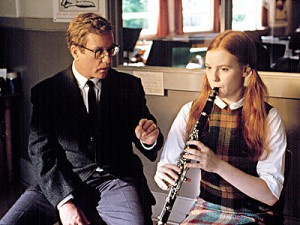
Richard DreyfussI love the movie Mr. Holland’s Opus with Richard Dreyfuss as a high school band teacher who dreams of the fame and glory of becoming a famous composer.  He never really gets his wish fulfilled, but feels he wastes his life teaching acne-faced, uncoordinated and un-rhythmic teenagers how to play musical instruments.  On the side he continues to write music, working on his “Opus” masterpiece throughout his lifetime.

At the end of the movie, after decades of teaching, Mr. Holland is forced into early retirement because of school budget cuts.  He’s older now, walks with more of a slouch, and we see him shuffling down the school hall after clearing out his desk for the last time.  And then there is this climatic scene that reminds me of a coming day in heaven.   He opens up the door to the school auditorium with his family and there is this huge surprise retirement celebration for him.  Past and present teachers and students are there, cheering like crazy as he walks down the aisle.  He takes his place at the front and is publicly honored by his former students, including the governor of the state whom he patiently taught to play clarinet.  Afterwards a wide-aged range of former students play for him his lifelong masterpiece, his Opus, and tears stream down his shocked face.  He realizes all of his sacrifice was worth it and that “life is what happens to you when you’re busy making other plans.”  His life really mattered, really impacted people, and now he is being celebrated with joy. (See the clip at http://www.youtube.com/watch?v=ng3l4vEN3Dk&feature=related)

That coming celebration, what the Bible calls the Judgment Seat of Christ, awaits those who have poured out their lives for God and for others.  Although our salvation is 100% dependent on God’s grace and not our good works (see Ephesians 2:8-9), we are going to be rewarded in heaven on that day for how we lived our lives:

So we make it our goal to please Him…For we must all appear before the judgment seat of Christ, that each one may receive what is due him for the things done while in the body, whether good or bad.[i]

Your life really matters.  You are impacting people.  You are making a difference.  And one day He will celebrate you— with great joy.  It’s all going to be worth it.  Let that coming joy be your strength today.


[i] 2Corinthians 5:10

Caged Eagles

IN JUNE 1944, WHILE WAITING TO BE EXECUTED in a Nazi prison cell, Dietrich Bonheoffer wrote some of the most soul searching poetry I’ve encountered.  The marching boots of certain death approached with each tick of the clock. In this condition of unimaginable anxiety, his words plunged with unmasked veracity into the freedom of truth.  In one poem called Who Am I? he wrote the following lines:

Am I really what others say about me? Or am I only what I know about myself? Restless, yearning and sick, like a bird in its cage, struggling for the breath of life, as though someone were choking my throat; hungering for colors, for flowers, for the songs of birds, thirsting for kind words and human closeness, shaking with anger at capricious tyranny and the pettiest slurs, bedeviled by anxiety, awaiting great events that might never occur, fearfully powerless and worried for friends far away, weary and empty in prayer, in thinking, in doing, weak, and ready to take leave of it all.

Who am I? This man or that other? Am I then this man today and tomorrow another? Am I both all at once? An imposter to others, but to me a little more than a whining, despicable weakling? Does what is in me compare to a vanquished army, that flees in disorder before a battle already won?

Who am I? They mock me, these lonely questions of mine. Whoever I am, you know me O God. You know I am yours.[1]

As Bonhoeffer writes, he draws from his doubts, his fears, his cravings, and the wounds and scars carved in his soul. Every word invites us to look beyond his eyes into the truth of his inner man. He is a trembling, fallen creature creating from a posture of brokenness and humility … and yet his poetry grips me, challenges me and confronts me with a radical creative freedom. He is simultaneously a “canary in a coal mine” and a golden eagle navigating the blustery skies of freedom.

Touching the world around us and bringing hope to others is rooted in an intensely personal, soul-searching experience. For some, our freedom to soar in a free and active faith, to hear God’s voice and respond to the people and circumstances around us, is gasping for oxygen beneath our layers of persona and self-defense. Our freedom to enjoy the faith we were created to live is pinned down, like an eagle trapped in a cage.

Jesus said that truth will set us free. I believe he was drawing a connection between living in truth and our ability to engage the wider world with genuine creative freedom. He wasn’t only telling us not to tell lies. He was confronting the widespread human addiction to living a lie. Only the soul that is free to breathe can become a free flowing river of God’s creative work. That work in us requires an environment of truth.  Perhaps this is why confession is so important to God.  The Spirit simply doesn’t respond to play acting. He is repelled by the dense fog of made up reality. He calls us to unmask, to bare our souls to him, and live in the freedom of the question, “Who am I?” With our feet standing on the firm ground of truth, the CREATOR goes to work, setting us free to create. 

“Surely you desire truth in the inner parts; you teach me wisdom in the inmost place.” — Psalm 51:6

[1] Geffrey B. Kelly and F. Burton Nelson, The Cost of Moral Leadership: The Spirituality of Dietrich Bonhoeffer (Grand Rapids: Eerdmans, 2003), 239-40.